

[Campus] President Kim Jin-sang Puts Students First, Plans Unified Campus Governance and Research-focused University

President Kim Jin-sang
Photo by Chung, So-young / The University Life
The 2026 President’s Talk with Students, titled “With Students’ Voices, Toward Kyung Hee’s Future,” was held at Neo-Renaissance Building on the Seoul Campus from 10:30 a.m. to noon on Oct. 14. The event gave students a chance to share their views on campus life and Kyung Hee University policies directly with the president and discuss the University’s future. The program included a welcome speech, a balance game, a talk by the president, responses to student issues submitted in advance, and a question-and-answer session with questions submitted before and during the event.
Putting Students First and Building a Research-focused University
President Kim Jin-sang said student growth and success should guide the University’s decisions. His answers during the opening balance game also reflected this view. He emphasized that students should come before research infrastructure and large government-funded projects. He stressed the need to improve classrooms and student facilities. He also said the University should improve student welfare and scholarship support. In education, he named improvements to academic programs and stronger interdisciplinary education as key priorities. He noted that graduates need a sense of community and critical thinking skills that will serve them throughout their lives, rather than just short-term achievements. When asked whether communication skills or management skills were more important for a university president, he said it was difficult to choose between the two.
In his following talk, Kim shared his vision for the University. He said the University must do more than earn high rankings to become a leading institution. It should also help solve problems facing humanity and the planet. To achieve the goal, he plans to develop 10 original research areas that gain international recognition within the next 10 years. He also said the University would bring research findings into the classroom. Another goal is to help third- and fourth-year undergraduate students develop research skills at the master’s level.
Kim also discussed career support. Ideally, he said, students should be able to prepare for their careers through their regular courses without needing separate programs. However, the University is developing a platform to track students’ skills and progress. He said the University was behind other institutions in this area.
Unified Campus Governance, University Finances and General Education: Responses to Student Issues
The General Student Association (GSA) collected student concerns in advance and selected three issues by lottery.
The first issue, “One Kyung Hee,” focused on differences in services for students, professors and staff between the Seoul and Global campuses. Kim acknowledged these differences. He said the University would first integrate its central administration so that one department head could oversee both campuses. He also promised to expand academic exchanges between the two.
The second issue, the “Shared Financial Plan,” asked how the University would make discussions about tuition increases more transparent. Kim said the University still relied heavily on tuition fees. He explained that it would seek other sources of income through faculty research, better use of campus space and extracurricular activities. He also said the University would prioritize investment in courses and facilities that students need. However, he did not provide specific budget plans or figures during the event. He said he had instructed the Office of Planning & Coordination to improve its plan and communicate it more clearly to students.
The third issue called for absolute grading in general education courses. Students argued that it could reduce stress from grade competition and allow them to explore different fields of study with less pressure. Kim said he understood students’ concerns about general education at Humanitas College and expressed regret that the current system had not met their expectations. He added that the new dean would lead discussions on changes to general education this semester, with an answer expected around the start of the next semester.
Kim believes grading should focus more on skills such as creative and critical thinking, communication and teamwork. However, he said absolute grading would not be introduced immediately. Students from different majors often take the same class, so the University would need to reorganize class sections first. He added that the University would study whether absolute grading could support its goal of assessing students based on their skills.

A student asking a question during the event
Questions on Majors, Disability Employment and Academic Policies
Questions submitted before the event included how the University would improve support for students pursuing multiple majors and interdisciplinary programs, as well as how it would offer more courses. Kim acknowledged that the majors students wanted to study did not always match the programs available. He said limited resources, including faculty and classroom space, made it difficult to offer every course students wanted. However, the University would survey student demand six months to a year in advance so it could plan course offerings more effectively.
During the open question-and-answer session, a student from the Student Minority and Human Rights Committee raised concerns about the University’s failure to meet its required employment quota for people with disabilities and the resulting financial penalties. The student asked the University to show commitment to addressing the issue, including by forming a task force. Kim said inclusion was a core value rooted in the University’s founding principles, but said the University had not yet fully realized it. He promised to review the request and work toward improvements.
Another student asked about the “Grade Eraser” system, which allows students to remove certain grades from their academic records. Under the current rules, students who had already used the previous grade withdrawal system to give up six credits could not apply. The student asked the University to change this restriction. Kim replied he would review ways to let as many students as possible use the system without being unfairly disadvantaged.
A question was also raised about installing artificial turf on the Grand Stadium of the Seoul Campus. Kim said natural grass was not a sustainable option and that the University was working to install artificial turf. He explained that the need for parking during events such as the entrance ceremony had made installation difficult. He also mentioned plans to secure parking spaces outside the campus and the possibility of financial support from the local government.
The event gave students a chance to ask the president directly about a range of University issues and hear his responses. The University, however, did not announce specific solutions on budget planning, absolute grading in general education or employment for people with disabilities.

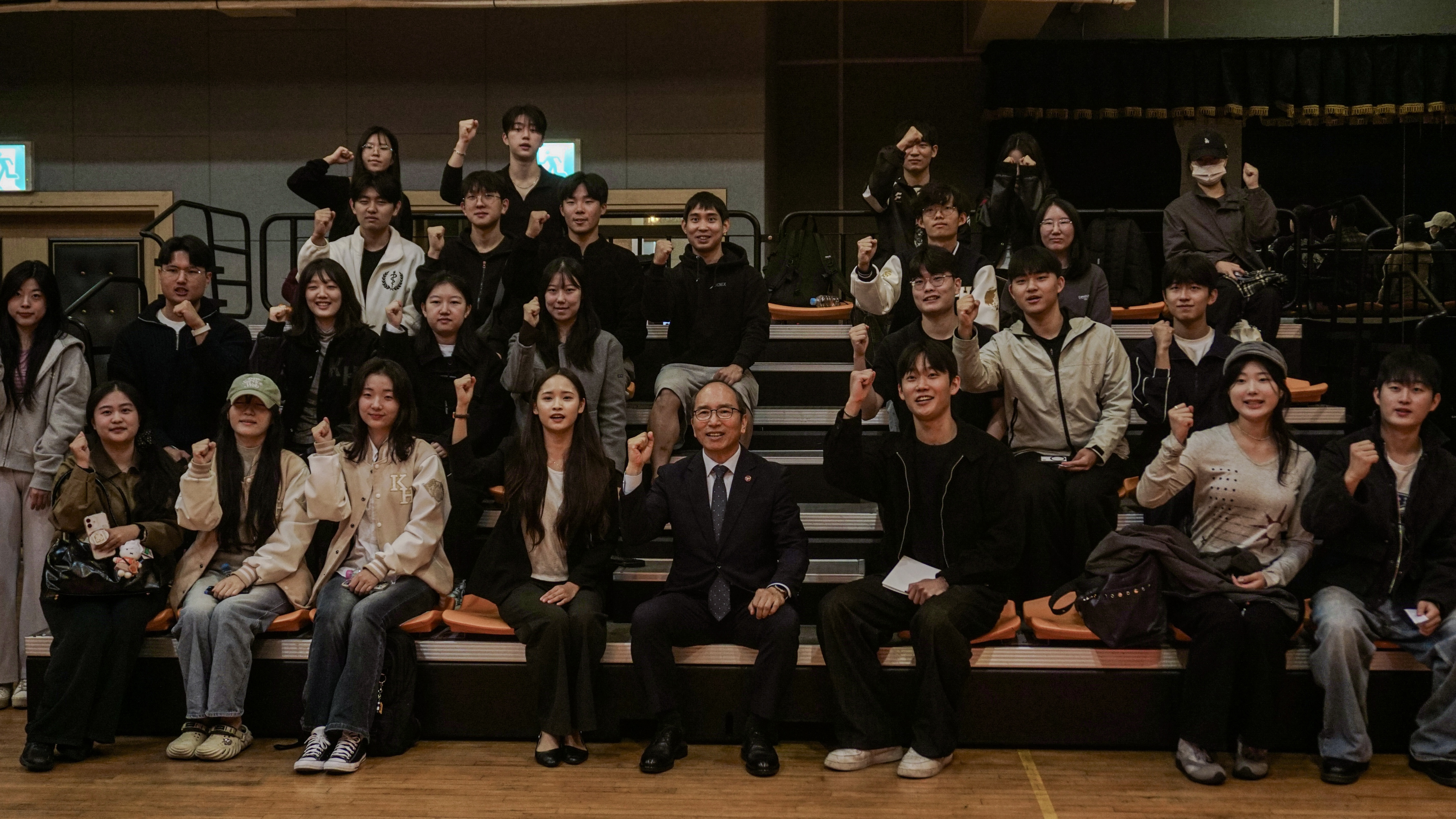
President Kim Jin-sang poses with students and GSA representatives
GSA President Shin Chang-hoon said he hoped the event would become an ongoing channel for communication rather than a one-time question-and-answer session. He said students’ concerns should lead to actual changes in University policies and operations. The GSA plans to organize and publish the issues raised and the president’s responses. It will also follow up with the University administration and monitor progress to ensure that the discussions lead to real changes.
There are no registered comments.
I agree to the collection of personal information. [view]