

[Campus] [2027 Seoul Election] AnKHor Presents Key Pledges at GSA Public Hearing

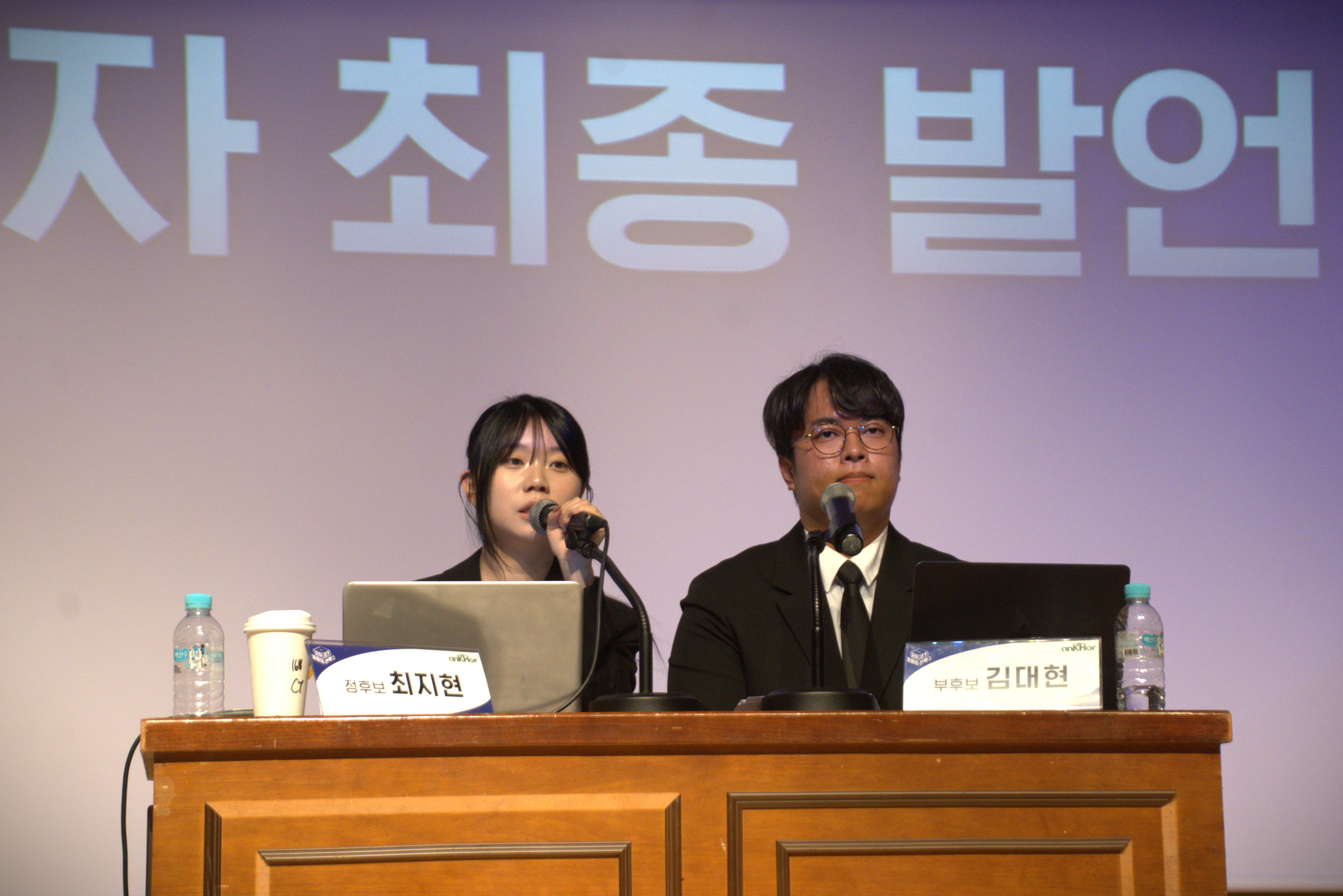
AnKHor's Choi Ji-hyun (right) and Kim Dae-hyun (left) at the GSA public hearing
The 2027 Seoul Campus General Student Association (GSA) election public hearing was held on November 19 in Room 111 of Orbis Hall. With AnKHor being the only team running in the election, the hearing included a policy speech, keyword questioning, media inquiries, and an additional Q&A. The session let the voters review the candidates’ key policies and examine their feasibility.
AnKHor’s Vision for Seoul Campus GSA
The policy speech began by introducing 3 meanings of the name ‘AnKHor’: a firm foundation for students’ rights, a speaker for students’ voices, and a hub connecting Kyung Hee University (KHU) and the local community.
The candidates categorized their main policies into their 3 key visions. For students’ right to learn and interests, they planned to expand the available options of P/NP courses in different majors, open more courses according to students’ demand, and apply absolute grading to the general elective courses.
Second, to enhance students’ sovereignty and communication with the University, they pledged to reform the electoral system in the 2028 University president election and implement a ‘Student Participatory Budget System’, organizing university-student consultative groups.
For students’ better campus life and career building, they announced their plan to reform campus facilities, increase study abroad opportunities, develop the KyungHee-in+ online platform, and promote local dormitory business in cooperation with Dongdaemun-gu.
Key Questioning: AnKHor on Solidarity, Agency, and Innovation
During the Keyword Questioning, AnKHor answered the questions from KHU media outlets—V.O.U., The University Life, and Daehak Jubo—under the 3 keywords first revealed at the venue.
“The problems that the students face are not limited to the university’s boundary,” said the presidential candidate, Choi Ji-hyun.
Answering the first keyword, ‘Solidarity and Coexistence,’ the team emphasised the cooperation between the two campuses and the local community, indicating their plan for a community dorm business. Within the University, they explained their plan to hold ‘The Night of KHU people’ event to help students build a wider network with the alumni beyond their major boundaries.
Under the second keyword, ‘Sovereignty,’ AnKHor stated their goal for the students to have the biggest influence on the University’s decisions. The candidates suggested a ‘Student Participatory Budget System’ and said they planned to “Hear students’ voice on allocating the budget.”
For the keyword ‘Innovation,’ they explained their design of the online platform ‘KyungHee-in+’, expecting it to bring further convenience in campus life and provide better access to different information. “It is focused on unifying the source of information and simplifying access processes,” Choi noted. They also planned to improve the electronic attendance system.
Media and Student Q&A Session

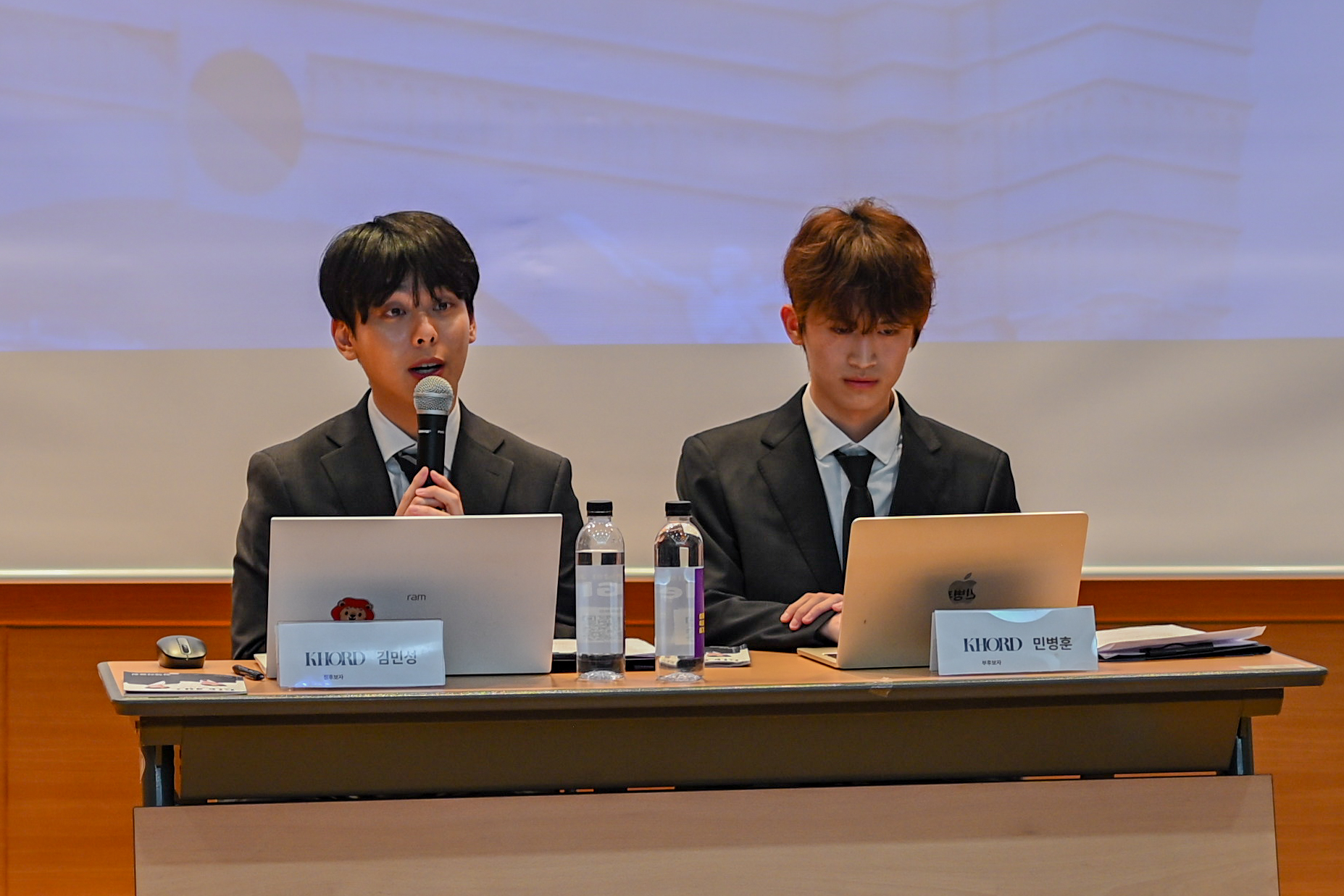
Reporters from university media outlets are making inquiries
The second part was followed by inquiries from the media outlets. Each outlet was given 20 minutes to question AnKHor.
The media outlets first questioned the candidate’s two policies: the application of absolute grading in general elective courses and the Dongdaemun-gu dorm business, especially their differences from the pledges of MATE, the current GSA.
Vice-presidential candidate Kim Dae-hyun pointed to the appointment of a dean for the Humanitas College at Global Campus, saying it could increase the possibility of changes to the grading system. “We will work to communicate students’ demands through regular meetings and by establishing the Committee on Humanitas College Innovation,” Kim added.
It was different from the community dorm business in that it will use existing housing facilities in Dongdaemun-gu, compared to MATE’s policy. Choi said that the pilot project will include 5 to 10 housing units in the community, and further development will be conducted according to the project results.
When asked about its pledge to expand student participation in the 2028 presidential selection process, AnKHor clarified that student voting would be used to narrow down the candidates rather than make the final appointment. They proposed introducing a process through which students could help narrow the pool of candidates to two or three, hoping this would encourage candidates to reflect student opinions in their policies and plans for the University’s future.
The discussion also addressed the low level of student participation in the previous presidential selection process. According to the figures raised during the hearing, student voter turnout was 39%, compared with 79.3% among faculty members. In response, AnKHor argued that students would be more willing to participate if they could see their opinions leading to tangible changes. They said that the ‘Student Participatory Budget System’ would be the breakthrough to the problem, showing the students that their voice can change the University.
Then the question turned to the selective P/NP grading system application on multiple major subjects. Choi said that the details should be discussed later, based on the current selective system. Kim pointed out that there are several concerns that the application could degrade students’ capacity. “The system is only for expanding available courses while it continues the current limit on the credits.”, he responded.
The issues of AI and a rigged election were also put on the table, and the candidates showed their understanding about them. For the AI cheating problem, Kim addressed the plan to look into the current systems of the University’s entrance examination and online courses and discuss further changes with the Office of Admissions.
For AI sex crimes, including Deepfake crimes, he directed that it is most likely to happen in large-scale events such as membership training, and will first handle the problem by reinforcing the group leaders’ education. “We will develop the guideline and build a rigid regulation followed by thorough discussion with the University.”, Kim added.
Then the discussion turned to the floor Q&A, and students asked about the detailed plans for the pledges.
For the pledge that the reform of campus facilities will be conducted under the students’ priorities, it was raised that the plan goes against the stance of the Office of Planning & Coordination, which previously said that the renovation is undergoing regarding to the observation data on the whole campus. In response, Choi explained that Student Participatory Budget System would make opportunities for reflecting student’s requirement to the University’s changes. “We will do our best to realise this unprecedented policy,” she added.
Following question was raised about AnKHor’s methods to bring students’ attention to apply the Student Participatory Budget System, or campus autonomy. Choi argued the necessity of building consensus on each issue, as students will show stronger engagement with the directly relevant agendas. She cited the result of a student survey on grade eraser policy whose participants were about 4,000, which outnumbers previous surveys by more than 3,500.
 AnKHor delivering their final remarks
In their closing remarks, AnKHor emphasized that the GSA’s primary responsibility is to turn students’ demands into tangible changes in university policies and systems. Choi also said, “We will avoid empty promises that we can solve all the problems on campus, but take full responsibility until the end.” They stated their pledge to pursue transparency in the policy process, understand different students’ perspectives, and build a stronger connection with the University headquarters. “We will thoroughly record every requirement, negotiation, and remaining task, so that the effort to reform the system could continue after AnKHor,” Kim added.
Students will be able to cast their votes in the election from November 23 to 25.
There are no registered comments.
- 1
- 2
- 3

I agree to the collection of personal information. [view]